USAJOBS Resume Builder Guide: Create a Focused Federal Resume in 2026
Follow the current USAJOBS resume requirements, translate specialized experience into evidence, use the resume builder, and review a complete federal application.
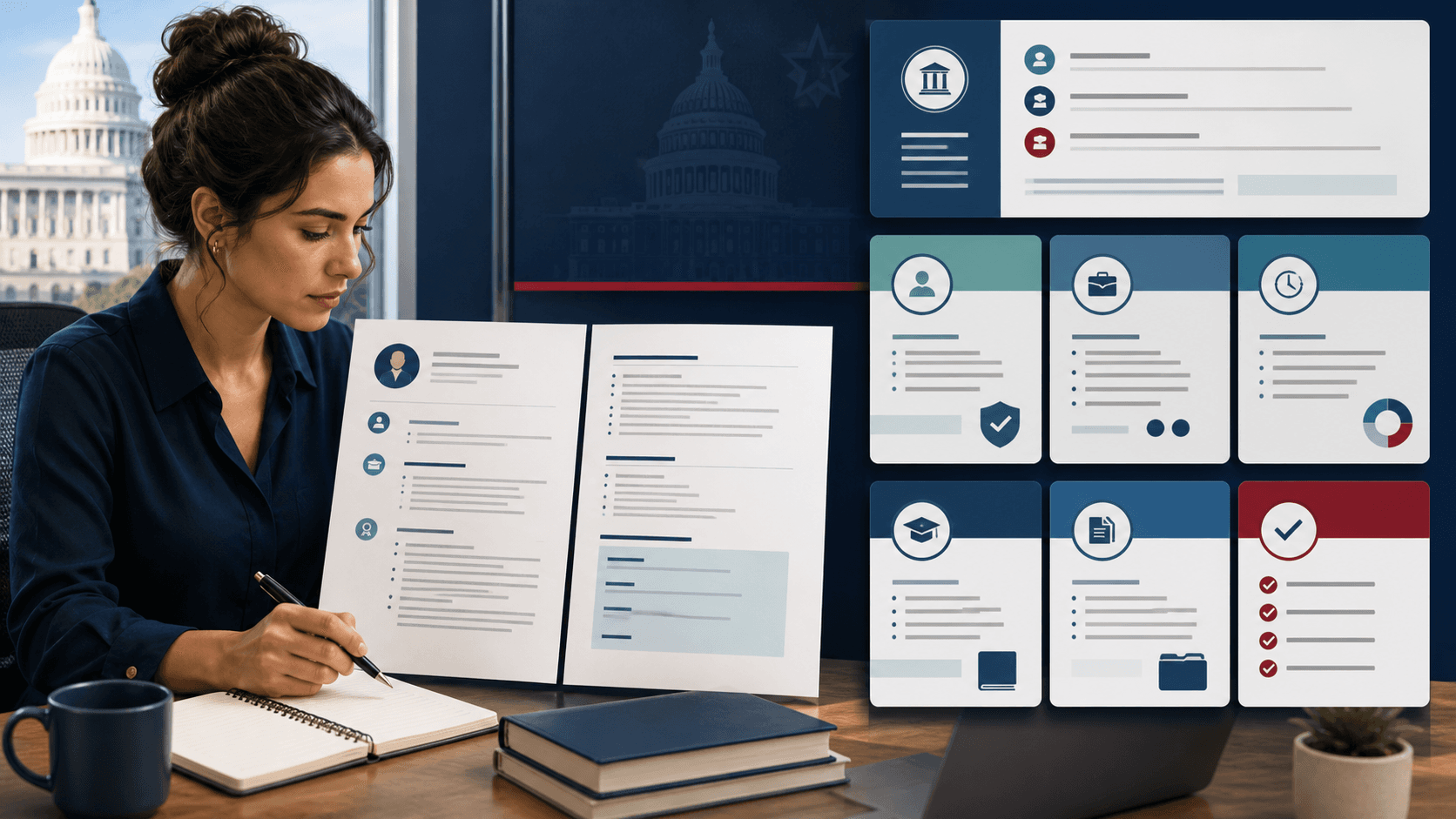
The USAJOBS resume builder is part of the federal government’s official employment platform. It helps candidates enter employment, education, and related information in a structure designed for federal applications. That structure is valuable because a federal reviewer cannot assume you meet a qualification. Your resume must show relevant work at the level described in the announcement and include details—such as hours per week—that may not appear in a private-sector resume.
Federal resume advice changed materially with the current two-page standard. USAJOBS now states that agencies accept standard resumes up to two pages under the Merit Hiring Plan, and the platform will not allow a longer standard resume to be built or uploaded. Some announcements may require an accepted long-form CV, clinical resume, or research resume, so the specific posting remains controlling. Old advice that every federal resume should be many pages is no longer a safe default.
This independent guide explains how to read an announcement, build an evidence map, use the USAJOBS fields, write specialized experience, edit to two pages, handle education and documents, and review the final package. It is not affiliated with or endorsed by USAJOBS or the U.S. government. Always confirm requirements in the live announcement and official Help Center before submission.
The USAJOBS resume builder helps applicants create and store resumes using information expected in federal hiring. Current USAJOBS guidance says standard resumes must be two pages or less. Read the entire announcement first, show how your experience meets each qualification, include month-and-year dates and hours per week, add series and grade for federal roles, attach required documents, and follow any announcement-specific exception or instruction.
Key takeaways
- Use the current two-page limit for standard USAJOBS resumes unless the announcement requires a permitted long-form document.
- Include employer, title, month-and-year dates, hours per week, and federal series and grade where applicable.
- Address specialized experience with concrete duties and accomplishments at the required level.
- Read eligibility, qualifications, evaluation, and required-documents sections together.
- Review the complete application package before continuing to the agency system.
Read the entire announcement before building the resume
Eligibility, qualifications, evaluation, and documents answer different questions.
Start with “Who may apply” or the hiring-path information. Eligibility determines whether you can be considered under that announcement; qualifications determine whether your background meets the role. A person can be eligible but not qualified, or qualified in experience but not eligible for the selected path. Record the evidence and documents associated with your status rather than assuming the resume alone completes the application.
Read Duties, Requirements, Qualifications, Specialized Experience, Education, How You Will Be Evaluated, How to Apply, and Required Documents. Preview an assessment questionnaire when the announcement provides one. These sections reveal the level, time period, technical work, conditions, credentials, and evidence the agency will use. Save a copy or notes because announcements can close and you will need the criteria for interview preparation.
Create a requirement table. Place each mandatory qualification and major duty in the first column. Add the role, project, education, or document that supports it in the second. Note the exact dates, hours, and level in the third. Gaps should remain visible. The USAJOBS resume builder cannot determine eligibility or invent qualifying experience; it can only organize the information you provide.
Practical checklist
- Hiring path and eligibility
- Qualifications and specialized experience
- Education substitution or positive education requirement
- Evaluation and assessment questions
- Required documents and submission deadline
Apply the current two-page federal resume rule
Prioritize proof rather than shrinking a long career history into unreadable text.
Current USAJOBS guidance says a resume must be two pages or less for standard federal applications. The builder and upload workflow enforce that limit. Use standard 8.5-by-11-inch pages and the platform’s current formatting guidance. Do not solve the limit with tiny type, narrow margins, dense abbreviations, or removed qualification details. Edit for relevance and make the strongest qualifying evidence easy to locate.
Begin with the specialized experience and required qualifications, not with equal space for every former job. Recent relevant roles normally deserve the most detail. Older or unrelated positions may be condensed or removed when they do not establish eligibility, continuity, or transferable evidence. A short federal resume can still be specific when each sentence has a clear purpose.
USAJOBS also explains that some jobs may request a long-form CV, clinical resume, or research resume instead of the standard two-page document. Follow that announcement’s instructions and allowed document type. The existence of an exception does not justify uploading a longer standard resume elsewhere. Check official guidance again when applying because federal procedures can change.
Include the employment details federal reviewers need
Dates, hours, and grade information can affect whether experience is creditable.
For each relevant work experience, include employer, job title, start and end dates with month and year, and hours worked per week. For federal positions, include the pay plan, occupational series, and grade. These details help reviewers understand duration and level. A private-sector format that lists only years or omits weekly hours may leave essential questions unanswered.
Use official titles, but add a short functional clarification when the title is unfamiliar and the description remains accurate. Explain acronyms the first time. USAJOBS recommends plain language because reviewers should not need insider knowledge of your previous organization. Include location only as requested or useful, and keep contact details current at the top.
Do not include classified or government-sensitive information, a Social Security number, a photograph, age, sex, religious affiliation, or other excluded personal information. Do not upload encrypted or digitally signed documents when the platform prohibits them. Federal experience can often be described through scope, process, decisions, and authorized outcomes without exposing protected operational details.
Practical checklist
- Employer and job title
- Start and end month and year
- Average hours worked per week
- Series and grade for federal employment
- Relevant duties and accomplishments at the required level
Prove specialized experience instead of naming it
Use concrete descriptions that show what you did and at what level.
Specialized experience is often defined as work closely related to the position and performed at a stated level or for a stated duration. Copy the definition into your private requirement map, then locate factual examples for every component. If the announcement requires analyzing program performance and briefing leaders, the resume should show where you performed those tasks, using which methods, for what scope, and with what consequence.
Write concise evidence statements. Start with an action, name the object or problem, explain a relevant method or judgment, and state the result when available. Quantities can show scale, but they must be accurate and releasable. Useful qualitative results include an approved recommendation, successful implementation, reduced risk, improved compliance, restored service, or better decision quality.
Use similar terminology when it truthfully describes your experience, especially named tools, regulations, methods, and program functions. Do not paste the announcement or claim qualifications you lack. The agency may compare the resume with questionnaire answers, supporting records, and later interviews. Consistency matters. If an example only partly matches, describe the real adjacent experience and let the reviewer evaluate it.
Use the USAJOBS resume builder methodically
Prepare clean source notes before entering fields into the platform.
Build a master evidence file outside the platform first. Include complete employment details, education, credentials, relevant volunteering, and accomplishment notes. Then create a targeted two-page version for the announcement. This protects your source history while preventing the builder from becoming a place where you improvise important dates and duties under deadline pressure.
Enter information consistently and preview the result. Confirm that fields did not truncate essential evidence and that entries appear in the intended order. The USAJOBS profile can help start the resume, but profile completion is not a substitute for tailoring. Duplicate or maintain targeted versions when the platform permits, and name them clearly by role, series, grade, or announcement.
If you upload your own document instead, follow current size and format requirements. USAJOBS recommends PDF to preserve formatting and accepts several other formats listed in its official guidance. The file must meet the current size limit and page limit. Never upload a portfolio PDF when the platform excludes it. Preview the file and the application package before continuing.
Practical checklist
- Maintain a private master evidence record
- Create a targeted version for the announcement
- Use complete dates and weekly hours
- Preview every field and page
- Keep document names clear across applications
Handle education, credentials, and required documents
The resume and supporting records must tell a consistent story.
When education is required or used to qualify, include the institution, degree type, completion date or expected status, and other information requested by the announcement. USAJOBS guidance identifies GPA as relevant in some education records, but the specific posting controls what must be shown. List licences and certifications with exact names and current status when the position requires them.
Read the Required Documents section for transcripts, SF-50 records, veterans’ preference forms, disability documentation, licences, certifications, writing samples, or other evidence relevant to your path. Some documents are conditional rather than universal. Upload the correct version and verify that it is legible, complete, and associated with the right document category.
A statement in the resume does not replace a required record. Conversely, attaching a transcript does not guarantee the reviewer will infer a qualification omitted from the resume. Align the documents without unnecessary sensitive detail. If instructions are unclear, use the agency contact listed in the announcement rather than relying on a general online answer.
Align assessment answers with genuine resume evidence
Answer honestly and make the supporting experience easy to find.
When an assessment asks about experience level, read each option carefully and choose the response that accurately reflects your work. Do not select the highest answer simply because the resume uses similar keywords. Reviewers may compare responses with the dates, hours, duties, and accomplishments in the application. Inflated answers can damage credibility or affect eligibility.
For important questionnaire topics, locate visible support in the resume. The evidence does not need to repeat the question word for word, but it should demonstrate the task at the claimed level. If supervision, independent judgment, regulatory application, or program scale matters, include enough context for the reviewer to evaluate it. Do not rely on a list of skills without examples.
Complete assessments and agency steps before the stated deadline. USAJOBS may transfer you to an agency system after you select the resume and documents. The application is not finished merely because the USAJOBS portion looks complete. Follow the status and confirmation instructions provided by both systems.
Review the complete federal application before submission
Perform a qualification, compliance, evidence, and document check.
For qualification review, compare the first page with the specialized-experience definition. Can a reviewer identify your main credentials and supporting experience quickly? For compliance review, verify two pages, accepted format, file size, contact details, dates, weekly hours, and federal series and grade. Follow any more specific announcement requirement.
For evidence review, check that every statement is factual, concise, and understandable outside your former workplace. Expand unfamiliar acronyms, remove unsupported superlatives, and confirm numbers. For document review, open every attachment, inspect page orientation and legibility, and confirm the correct transcript, form, or record was selected. Missing documentation can prevent consideration even when the resume is strong.
Save the submitted announcement, resume, questionnaire notes, and document checklist in a secure application folder. These materials help you prepare for an interview and understand later status messages. Federal hiring can involve several systems and stages; organized records reduce avoidable confusion. When official instructions change, update your process rather than copying an old application unchanged.
Practical checklist
- Two pages or approved announcement-specific exception
- Qualifications visible in evidence
- Dates, hours, series, and grade checked
- Required attachments opened and verified
- Final agency step completed and confirmation saved
Frequently asked questions
How long can a USAJOBS resume be in 2026?
Current official USAJOBS guidance says a standard resume must be two pages or less, and the platform will not accept or build a longer standard resume. Some announcements may request an accepted long-form CV or specialist document, so follow the live posting.
What details should each job include?
For relevant experience, include employer, title, start and end month and year, hours worked per week, and descriptions showing qualification-level duties and accomplishments. Include series and grade for federal roles.
Should I use the USAJOBS resume builder or upload a PDF?
Either may be permitted. The builder prompts for useful federal details, while an uploaded PDF gives layout control. Both must meet current page, file, content, and announcement requirements.
Do I need a different federal resume for every job?
Create a targeted version for each materially different announcement. The facts remain consistent, but the selection and order should make relevant specialized experience easy to evaluate.
Can I copy specialized-experience language into my resume?
Use the announcement’s terminology when it accurately describes your work, but support it with specific evidence. Copying requirements without proving where, when, and how you performed them is not sufficient.
Is this website affiliated with USAJOBS?
No. CurriculumVitaeMaker.com is an independent service. Use the official USAJOBS website and Help Center as the controlling source for federal application requirements.
Public guidance used in this article
These sources support the general workflow and conventions in this guide. Regional, professional, and employer instructions can differ, so use the destination’s requirements when they are more specific.
- USAJOBS Help Center — How do I write a resume for a federal job?Primary current requirements for length, content, relevant experience, formatting, exclusions, and accepted file types.
- USAJOBS Help Center — What documents do I need?Official guidance on resumes, transcripts, preferences, certifications, federal records, and announcement-specific documents.
- USAJOBS Help Center — How does the application process work?Official overview of profile preparation, announcement review, application steps, documents, and agency submission.
Read more about our editorial standards and responsible AI approach.
Turn the guidance into a finished document
Use the builder to organize your evidence, choose a readable template, and review the final file before applying.