How to Build Your Resume and Create Your Resume From Scratch
A detailed, practical workbook for turning a blank page into a truthful, role-focused resume—from evidence collection and section writing to tailoring, proofreading, and submission.
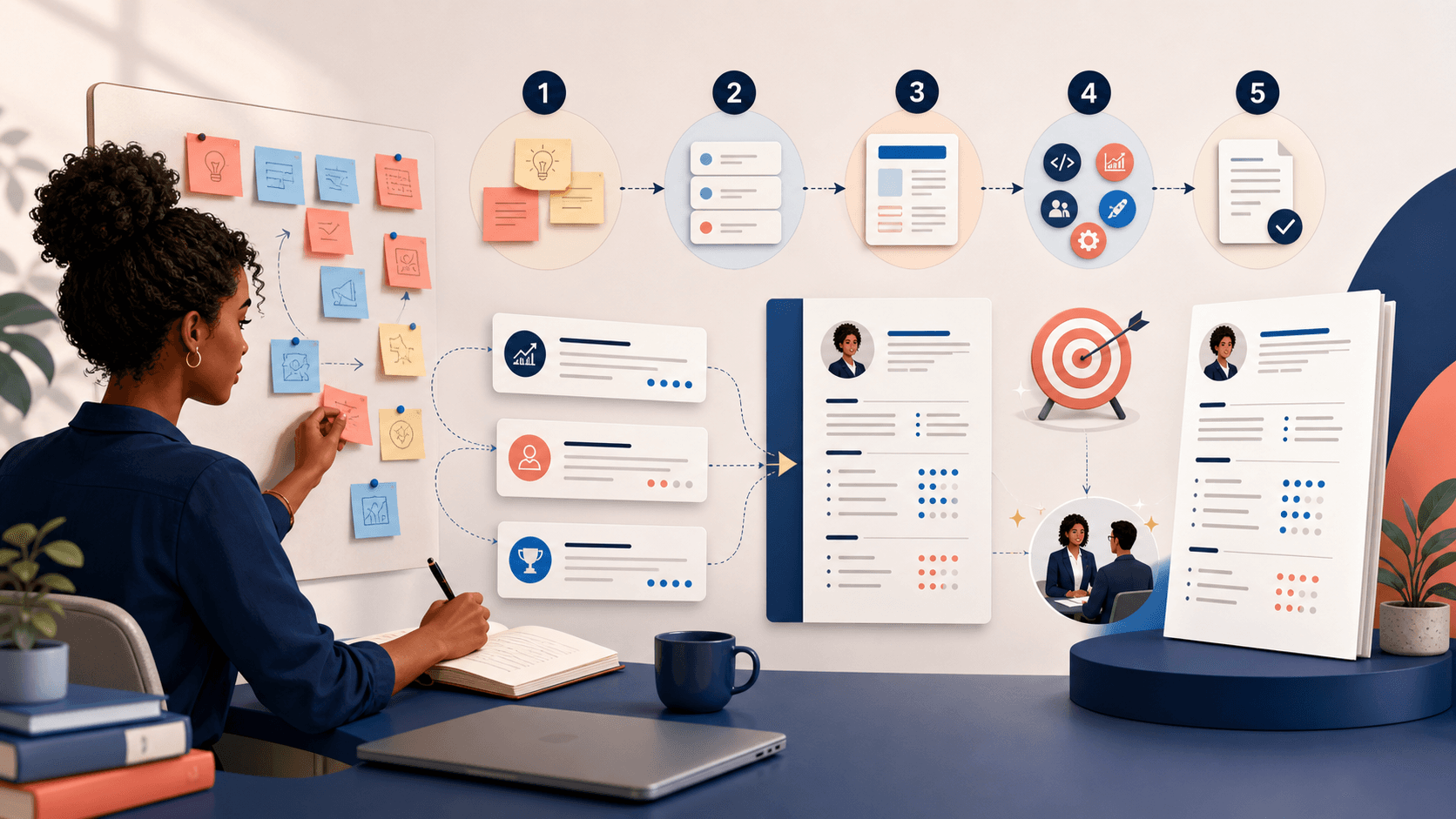
The instruction “build your resume” sounds simple until a blank document asks you to summarize years of work in a few pages. The difficulty is not typing. It is deciding what matters, retrieving credible examples, finding the right level of detail, and arranging the result for a reader who has limited time. This guide breaks the work into separate decisions so you do not try to remember, write, design, and proofread simultaneously. The result is a calmer process and a document built from evidence rather than pressure.
You can create your resume without beginning with a template. In fact, content becomes stronger when you first establish the target and gather a complete record of roles, projects, qualifications, tools, decisions, and outcomes. Once the source material exists, a template provides hierarchy instead of dictating what you say. You can then create your resume for one role, duplicate it for another, and keep the factual foundation stable while changing relevance and emphasis.
Use this as a working handbook. Each chapter contains a decision, a method, and a quality check. By the end, you will know how to build your resume section by section, tailor it without copying unsupported language, and create your resume in a format that can be read by both people and common applicant systems. The examples are deliberately generic structures. Replace them with your own facts, voice, and sector conventions before submitting anything.
To build your resume from scratch, choose a realistic target, collect a verified career inventory, select the evidence that proves fit, write each section before styling it, and inspect the final export. Create your resume as a truthful decision document rather than a complete autobiography.
Key takeaways
- Choose the target before deciding what earns space.
- Separate evidence collection from polished writing.
- Make every summary claim traceable to experience or projects.
- Tailor through genuine requirement-to-evidence matches.
- Proofread facts, language, and visual output in separate passes.
Choose a clear target before you build your resume
A resume cannot emphasize everything equally; direction determines what earns space.
Start with a role family, level, and environment rather than an impossibly broad objective. “Marketing” could mean brand strategy, demand generation, product marketing, communications, or content operations. Each target values different evidence. Collect three to five realistic role descriptions and highlight repeated responsibilities, outcomes, tools, stakeholder groups, and seniority signals. The overlap gives you a stable target while differences show what must be adjusted for individual employers.
Write a one-sentence target statement for yourself: “I am pursuing operations manager roles where multi-site delivery, process improvement, and team leadership matter.” This sentence may never appear in the document, but it guides selection. As you create your resume, ask whether each section helps establish that fit. Content can be impressive and still be irrelevant. A focused target gives you permission to shorten or remove material that distracts from the professional argument.
If you need to build your resume for two distinct directions, create two source outlines after maintaining one factual career inventory. For example, a teacher moving toward learning design might prepare one version for instructional design and another for customer education. The dates and employers remain unchanged, while project selection, terminology, and opening emphasis differ. This avoids a single document filled with competing identities.
Practical checklist
- Collect several realistic role descriptions
- Identify repeated outcomes, responsibilities, tools, and stakeholders
- Choose a truthful target level
- Write a private one-sentence direction statement
- Create separate versions for materially different targets
Collect source material before you create your resume
Retrieving evidence is a separate task from compressing it into polished language.
Gather old resumes, role descriptions, performance reviews, project plans, calendars, portfolios, presentations, training records, and appropriate business reports. Use them as memory prompts, not text to copy without review. Create a timeline with employer, title, location, and month-and-year dates. Then add projects, responsibilities, decisions, audiences, tools, constraints, and outcomes beneath each role. Mark any date or figure that needs verification.
To build your resume from strong material, ask specific retrieval questions. What process did you inherit? What was slow, risky, confusing, expensive, or inconsistent? Who depended on your work? What did you decide, build, negotiate, analyze, teach, or deliver? What changed afterward? Specific questions produce usable notes, while “What did I achieve?” often produces a blank mind. Speak the answers into notes if writing feels slow; editing comes later.
When you create your resume, distinguish private source detail from publishable information. Keep confidential customer names, personal data, security information, trade secrets, and protected financial data out of the document and any AI prompt. You can still describe scale and complexity at an authorized level. A source inventory is valuable because it preserves context, but it also requires careful judgment about what may be shared.
Practical checklist
- A verified employment and education timeline
- Raw notes for projects, actions, methods, scope, and outcomes
- A list of tools, qualifications, licences, and languages
- Examples of feedback, recognition, presentations, or leadership
- Clear flags for confidential or unverified information
Decide the section order that supports your strongest evidence
The reader should encounter the most decision-relevant information early.
Most professional resumes begin with contact details, a headline or summary, recent experience, education, and skills. That default can change when another section provides stronger evidence. A recent graduate may place education and projects above limited work history. A researcher may need publications, grants, and teaching. A certified technical professional may need licences near the opening. Use sector expectations and reader needs rather than novelty.
As you build your resume, sketch the order in plain text before applying a visual layout. This exposes whether important content is buried. It also prevents a template from forcing secondary details into the most prominent space. Every included section should answer a reader question: Who is this person? What have they done? What can they do? What qualifies them? What relevant evidence is available beyond employment?
When you create your resume for a new target, section order may change without altering facts. A career changer can use a concise skills-and-evidence overview before chronological experience, while still keeping dates transparent. Avoid a purely functional format designed to hide chronology. A hybrid approach usually provides both relevance and trust: focused opening, evidence-led skills where useful, then clear work history.
Write safe, professional contact information
Make response easy while limiting unnecessary personal data.
Use your professional name, current phone number, monitored email address, and an appropriate location. City and country or region are commonly sufficient. Add LinkedIn, a portfolio, publication profile, or code repository only if it is relevant, current, and ready for employer review. Use descriptive link labels where possible and test every link in the exported file. A broken portfolio creates more doubt than no portfolio.
Do not add passwords, identity numbers, banking details, a full street address, or unrelated personal information when you build your resume. Photographs, age, marital status, and nationality expectations vary by region and sector; investigate the convention and legal context of the target market. When uncertain, prioritize information directly connected to contact and professional evaluation.
As you create your resume, make the opening visually calm. Your name should be easy to find, the headline should establish direction, and contact details should not dominate the page. Icons can support scanning but should not replace text labels entirely. Copy the header into plain text during quality control to confirm that an automated system and an assistive technology user encounter the information in a sensible order.
Practical checklist
- Professional name
- Role-aligned headline
- Reliable email and phone number
- Appropriate city, region, or country
- Only relevant and tested professional links
Write a role-aligned headline without exaggeration
The headline is orientation, not a place to claim unsupported seniority.
A useful headline combines a recognizable professional identity with one or two relevant specialisms. “Finance Business Partner | Forecasting, Commercial Analysis and Decision Support” tells the reader more than “Finance Professional.” Use an official current title when it fits the target, or use a truthful broader identity. Career changers can name the target capability while anchoring it in existing experience.
To build your resume for search and human scanning, include terminology employers actually use where it accurately describes you. Do not create a long chain of job titles separated by slashes. That approach communicates uncertainty and consumes the most prominent line. Choose the best-fit identity for the version, then let the summary and evidence show range.
When you create your resume for another role, duplicate the version and adjust the headline rather than building a universal header. A project manager applying to implementation roles may emphasize delivery and stakeholder coordination; the same person applying to program operations may emphasize governance and cross-functional systems. The experience remains truthful while the lens becomes more relevant.
Draft the professional summary after the evidence sections
A summary is easier to write when you already know what the document proves.
Complete recent experience and selected skills before writing the summary. Then identify the pattern: level, specialist context, recurring capabilities, and one or two indicators of scope or outcome. Use three to five compact lines for many private-sector roles. Avoid opening with a personal objective focused only on what you want; show how your background connects to the employer’s needs.
As you build your resume, make every summary claim traceable. If you say you lead transformation, recent experience should show a change initiative, stakeholders, your ownership, and an outcome. If you claim customer insight expertise, show research, analysis, decisions, or improvements. Remove adjectives that the reader cannot verify. “Strategic” becomes credible through decisions and consequences, not repetition.
When you create your resume for a specific employer, revise the summary with restraint. Bring the most relevant capability forward and use accurate sector terminology. Do not paste the job description or stack keywords into a sentence with no meaning. Read the summary aloud; it should sound like a concise professional introduction you could comfortably say in an interview.
Practical checklist
- Professional level and identity
- Relevant domain, market, or operating environment
- Two or three evidenced capabilities
- Credible scope, qualification, or outcome
- Natural language that can be defended
Structure work experience for chronology and fast evaluation
Give the reader consistent context before asking them to assess achievements.
Use reverse chronological order for most professional applications. For every role, include employer, title, location where helpful, and dates in the same format. If the organization is unfamiliar, add a concise scope line such as industry, customer group, or scale. Group promotions under one employer when that makes progression clearer. Explain contract or consulting relationships accurately so the reader understands who employed you and where the work occurred.
To build your resume with balanced detail, allocate more space to recent and relevant roles. Older positions can use fewer bullets or a short earlier-career section. Do not repeat the same duty beneath several jobs. Instead, show increasing scope, different challenges, or stronger outcomes. The goal is not to prove that you performed every possible task; it is to establish the evidence most predictive of success in the target role.
When you create your resume, keep titles truthful. If an internal title is unclear, add a widely understood equivalent in parentheses only when it accurately reflects the work. Never upgrade a title to appear senior. Context can show level more credibly through team size, decision authority, budget, stakeholders, and business impact.
Write experience bullets that show action and consequence
Strong bullets make your contribution visible without turning every sentence into a slogan.
Begin with the most meaningful contribution, not “responsible for.” Name what you changed or delivered, how you approached it, and why it mattered. A useful pattern is action + object + method or context + outcome. The pattern is flexible: sometimes the result should lead because it is remarkable; sometimes the challenge needs one phrase of context. Keep the sentence readable rather than forcing every possible element into one line.
As you build your resume, replace vague scale words with evidence. “Large team,” “many customers,” and “significant savings” leave the reader guessing. Use a verified number, range, percentage, frequency, geography, or stakeholder description when authorized. If measurement is unavailable, specify complexity, quality, adoption, risk, or successful completion. Never invent a metric to satisfy a template suggestion.
When you create your resume from rough notes, draft long and then compress. The long version protects the logic: problem, decision, action, and effect. Remove setup the reader does not need, combine repeated phrases, and keep the distinctive detail. Editing a factual paragraph into a bullet is safer than asking a blank-page generator to invent a polished achievement.
Practical checklist
- Start with a specific action or outcome
- Identify the process, product, audience, system, or decision affected
- Add method, collaboration, or constraint when it matters
- State a verified quantitative or qualitative result
- Keep only detail that improves evaluation
Quantify achievements without manufacturing precision
Metrics need a baseline, period, and credible relationship to your work.
Look for measures of money, time, volume, quality, risk, growth, adoption, satisfaction, retention, reach, delivery, or team scope. Ask what changed from what baseline and over what period. “Reduced average onboarding time from twelve days to eight over two quarters” carries more meaning than “improved onboarding by 33%” alone. The underlying operational result is easier to discuss and verify.
To build your resume ethically, distinguish contribution from sole attribution. A team result can still be powerful when you name your part: developed the model, led implementation, coordinated stakeholders, or owned one workstream. Do not convert company revenue into a personal result if your influence was indirect. Use verbs and context that reflect real ownership.
When you create your resume for work involving confidential figures, generalize carefully. An authorized percentage, range, rank, or description of operational significance may preserve impact. If disclosure is not allowed, focus on decision, scale, complexity, and qualitative outcome. An interview-ready sentence is better than an impressive line that risks trust or confidentiality.
Select skills that the rest of the resume can prove
Use the skills section as a concise navigation aid for the reader.
Group relevant tools, methodologies, technical capabilities, languages, licences, and certifications in a way the target sector recognizes. Remove generic traits that appear on almost every application unless the context requires them. Communication, leadership, and problem solving become credible through examples. A skills list should help the reader locate strengths already demonstrated elsewhere.
As you build your resume, compare the role language with your honest vocabulary. Include both a broader capability and a specific tool when useful: customer relationship management and Salesforce, data visualization and Power BI, project planning and Jira. Do not add a platform solely because it appears in the description. If your experience is adjacent, state the actual tool and transferable method rather than implying direct use.
When you create your resume for multiple targets, keep a master inventory and select a shorter subset for each copy. Include proficiency or certification status only when meaningful and accurate. Review the list for stale software, expired credentials, and skills you would not want tested in an interview. Space saved here can support a stronger achievement.
Practical checklist
- Relevant tools and technical methods
- Current licences and certifications
- Languages with honest proficiency where relevant
- Major capabilities supported by experience or projects
- No hidden, repeated, expired, or unsupported keywords
Use education, projects, and additional evidence strategically
The right detail depends on experience level, profession, and target requirements.
Include qualification, institution, and completion date or expected date. Early-career applicants may add selected modules, projects, awards, strong results, and leadership because education is recent evidence. Experienced professionals can usually shorten older education and prioritize recent work or specialist development. Regulated roles may require exact licence, registration, and continuing education information.
To build your resume with relevant projects, describe them like experience. State the objective, your role, methods, collaboration, and outcome. Personal and academic projects can prove capability when the standard of work is clear. Link to a portfolio only after checking access permissions, context, mobile behavior, and removal of confidential information.
When you create your resume, optional sections should earn their space. Publications, presentations, volunteering, memberships, awards, languages, and interests can distinguish a candidate when they support the role or reveal meaningful evidence. Avoid adding low-relevance detail simply to make the page look full. A shorter, better-supported document is more persuasive than an inflated one.
Use AI to edit your evidence, not create your history
A fluent sentence still requires factual review.
AI can help propose bullet structures, shorten repetition, identify vague language, and compare a draft with role requirements. The quality of the output depends on the input. Provide your actual role, action, methods, scope, and result, then request several concise alternatives. Explain the intended audience and tone. A prompt containing evidence gives the model something useful to edit.
As you build your resume with AI, compare every output against your source inventory. Check whether the tool changed “supported” to “led,” added a metric, assumed a technology, overstated seniority, or converted a team result into individual ownership. Remove generic phrases that could describe anyone. Keep the sentence only when it remains accurate and sounds like a professional version of your voice.
When you create your resume, do not enter confidential customer details, identity information, passwords, health data, financial credentials, or employer trade secrets into prompts. Generalize context when necessary. Disclose AI assistance if an application process specifically asks, and always complete an independent human review. The applicant—not the generator—owns the submitted claim.
Practical checklist
- Begin with verified facts
- Request alternatives with a clear length and audience
- Compare wording with the source note
- Reject unsupported ownership, numbers, tools, or qualifications
- Edit for natural voice and interview defensibility
Tailor with a requirement-to-evidence map
Systematic tailoring is faster and more accurate than scattered keyword replacement.
Create a small table with important requirements in one column and your strongest evidence in another. Add where the evidence appears in the resume and whether it needs clearer scope or outcome. Prioritize requirements that are repeated, essential, or central to the job’s purpose. This map reveals genuine strengths and honest gaps before you begin changing sentences.
To build your resume for the role, revise the opening, reorder selected bullets, choose appropriate skills, and remove distracting detail. Use employer language when it is a truthful description of your experience. Do not copy complete sentences or add requirements you have never performed. Tailoring should make relevant evidence easier to find, not manufacture a match.
When you create your resume copy, name it with the employer and role and preserve the source version. Read the tailored document independently from the job description. It should still sound coherent rather than like a list of borrowed phrases. Then compare the two one final time to confirm that major genuine matches are visible and no essential application instruction has been missed.
Practical checklist
- Five to eight decision-relevant requirements
- One or more truthful examples for each genuine match
- Evidence location in summary, skills, experience, or projects
- Clear gaps left honest rather than disguised
- Final natural-language and application-instruction review
Choose a readable design after the writing works
A template should reinforce structure and reduce formatting work.
Choose a layout that suits the volume and hierarchy of your content. A one-column design is versatile and gives experience bullets full width. A careful two-column design can keep secondary information compact, but the reading order must remain clear. Avoid layouts where essential content depends on graphics, photographs, rating bars, or decorative text boxes.
As you build your resume, use consistent heading levels, dates, bullet indentation, spacing, and typography. Keep contrast strong and body text readable at ordinary zoom. If content does not fit, edit repetition and low-relevance detail before shrinking the type. Watch for a heading stranded at the bottom of a page or a single bullet creating an unnecessary new page.
When you create your resume PDF, the browser or export engine may produce different breaks from the live editor. Inspect the downloaded file at 100 percent, test links, and copy text into a plain document to see whether the reading order survives. Design quality includes technical output, not only the editor preview.
Proofread in separate factual, language, and visual passes
Trying to check everything at once makes familiar errors invisible.
First verify facts: name, contact details, links, titles, employers, dates, qualifications, tools, and metrics. Use source records for anything uncertain. Second review relevance and logic: does the opening match the target, and does recent experience prove the main claims? Third review language: spelling, tense, punctuation, abbreviations, repeated openings, and vague statements. Read aloud or use text-to-speech to hear missing words.
As you build your resume quality routine, take a break before the final review. Change the viewing format, print it, or read from the bottom upward sentence by sentence. Familiar layout encourages the brain to see what it expects. Ask a trusted person what they understand after thirty seconds and which evidence feels strongest. Their answer tests communication, not merely grammar.
When you create your resume export, check page size, scale, headers and footers, clipping, selectable text, and hyperlinks. Follow the requested file format and use a descriptive name. Open the exact attached file before sending. The final inspection should happen after every meaningful content or template change, because a small edit can move a page break.
Practical checklist
- Verified facts and contact details
- Clear fit and traceable summary claims
- Consistent spelling, grammar, tense, and punctuation
- Readable page breaks and working links
- Correct file type, filename, and attachment
Submit the resume with the right context and records
The application process continues after the document is finished.
Follow the employer’s instructions even when your preferred format differs. Complete required application fields accurately rather than writing “see resume” everywhere. If a cover letter is requested, connect selected evidence to the organization and role instead of repeating the resume line by line. Keep answers consistent across the application, professional profile, and submitted document.
To build your resume into a reusable interview asset, save the submitted version with the job description and date. Record the application channel, contact, deadline, and any questions answered in the form. If an interview follows, review the exact evidence and prepare deeper context: situation, decisions, trade-offs, collaboration, results, and learning. This prevents confusion when several tailored copies exist.
When you create your resume process, include a respectful follow-up plan where appropriate. Avoid constant edits after submission unless the employer requests an update or a serious factual error must be corrected. Use outcomes to improve future versions: note which examples prompted questions, which requirements were hard to evidence, and what new experience or learning would close a genuine gap.
Practical checklist
- Application instructions followed exactly
- Submitted version and job description archived together
- Form answers consistent with the resume
- Interview examples prepared from the submitted evidence
- Lessons captured for future applications
Maintain the source record after you create your resume
A small evidence habit prevents a future blank-page crisis.
Set a monthly or quarterly reminder to record projects, decisions, results, positive feedback, new tools, presentations, qualifications, and changes in responsibility. Capture the baseline, period, and source for important metrics. This record does not need polished language. Its purpose is to preserve facts while they are fresh and while supporting information is still available.
As you build your resume over time, keep the complete source broader than any submitted version. Archive old copies, remove obsolete public links, update expiring certifications, and check that contact details remain current. Preserve final documents for important applications, but avoid an uncontrolled collection of almost identical files. Clear naming and dates make the system usable.
The next time you create your resume for an opportunity, start from verified evidence rather than memory. Duplicate the closest relevant version, update the target map, and revise the limited sections that affect fit. Maintenance turns resume writing from an emergency into a normal professional practice and produces more accurate, specific applications.
Use application and interview feedback to build your resume better
A resume becomes more useful when real conversations reveal what readers understand, question, or overlook.
Keep a simple record of the version sent, the role requirements, the stage reached, and the questions an employer asked. One rejection does not prove that a sentence or template failed; hiring outcomes depend on competition, timing, criteria, and factors you cannot observe. Look for patterns across several relevant applications. If interviewers repeatedly ask for the scale of a project, the document may need clearer context. If a major capability never enters the conversation, it may be buried or unsupported.
After each useful conversation, build your resume source record with details that were easy to explain but missing from the page. Capture the decision, stakeholders, trade-offs, obstacle, and learning behind an achievement. Do not add every interview story to the next document. Instead, decide whether one concise detail would make the evidence more evaluable. The goal is a clearer application, not a transcript of everything you could discuss.
When you create your resume again, compare changes in controlled groups. Adjust the target, opening, and strongest evidence while keeping accurate history stable. Avoid constantly changing colors or rewriting every bullet because one employer did not respond. Ask a trusted reviewer in the target field to describe the professional story, level, and strongest proof. Specific feedback about comprehension is more useful than a general opinion that the resume “looks good.”
Practical checklist
- Archive the exact version and job description
- Record recurring questions and points of confusion
- Add missing context to the private evidence inventory
- Change evidence and emphasis for a reason
- Judge patterns across relevant applications rather than one outcome
Frequently asked questions
Where should I start when I need to build my resume?
Start with a realistic target and a factual timeline, not a template. Collect role descriptions, projects, responsibilities, tools, decisions, and outcomes. Once the source inventory exists, build your resume by selecting relevant evidence and arranging it for the target reader.
Can I create my resume with no formal work experience?
Yes. Create your resume from projects, education, placements, part-time work, volunteering, caring responsibilities, societies, and other contexts where you solved problems or delivered outcomes. Explain your contribution, method, and result rather than apologizing for limited full-time experience.
How long does it take to build your resume properly?
The first complete version may require several focused sessions because evidence retrieval, writing, design, and review are different tasks. Future copies are faster when the source record is maintained. Do not create your resume under one rushed pass if you can separate collection, drafting, and proofreading.
Should I create my resume for every individual job?
Maintain one complete source record and create focused copies for materially different roles or employers. You do not need to rewrite every sentence. Adjust the opening, selected skills, and order of relevant achievements, then build your resume copy around genuine requirement-to-evidence matches.
Can AI build your resume for you?
AI can help structure and edit facts you provide, but it cannot verify your career. Use it to propose alternatives and reduce repetition. To create your resume responsibly, check every suggestion for invented scope, metrics, tools, qualifications, and ownership before keeping it.
Which file type should I use when I create my resume?
Follow the employer’s instruction. PDF commonly preserves layout, while some processes request Word or an application form. After you build your resume, inspect the exact exported file for selectable text, correct page breaks, working links, and removal of browser headers and footers.
How do I build my resume for an ATS?
Use recognizable headings, selectable text, consistent dates, relevant terminology in natural context, and evidence that supports major skills. Avoid hidden keywords and complex decorative structures for essential information. Build your resume for human clarity as well because people ultimately evaluate the application.
What should I remove when I create my resume?
Remove repetition, outdated or unrelated skills, unsupported claims, unnecessary personal data, expired links, and detail that does not help the target reader evaluate fit. Create your resume with enough evidence to support a decision, not enough text to document every task you have performed.
How can I build my resume after a career gap?
Use accurate dates and add a brief neutral entry when relevant activity or context helps the timeline. Emphasize recent readiness through projects, training, volunteering, consulting, or transferable evidence. Do not build your resume around hiding the gap; build it around credible fit for the next role.
What is the last step after I create my resume?
Verify facts, read for relevance and language, inspect the exported file, follow application instructions, and archive the submitted version with the job description. After you create your resume and apply, prepare deeper interview examples from the exact evidence the employer received.
Public guidance used in this article
These sources support the general workflow and conventions in this guide. Regional, professional, and employer instructions can differ, so use the destination’s requirements when they are more specific.
- UK National Careers Service — How to write a CVPublic guidance on contact details, introductions, education, work history, gaps, tailoring, and proofreading.
- European Union Europass — Profile and CV differencesOfficial explanation of keeping a complete profile and selecting information for tailored applications.
Read more about our editorial standards and responsible AI approach.
Turn the guidance into a finished document
Use the builder to organize your evidence, choose a readable template, and review the final file before applying.